


When people think about securing a motorcycle, tethering a caravan, immobilising garden equipment, or protecting a bicycle, the immediate focus tends to fall on the chain or rope itself. What gauge? What material? How long? These are valid questions - but they miss something more fundamental. The chain or rope is only ever as strong as what it is attached to. An attacker who cannot defeat the chain will simply move to the weakest point in the system, and if that weakest point is the fixing, the entire setup fails regardless of how much you invested in the chain itself.
This guide covers anchoring and fixing points in detail - what they are, when to use each type, how to fit them correctly, and why getting this right is the difference between a security setup that genuinely protects your property and one that merely looks like it does.
Why the Anchor Point is the Critical Link
Think of any chain or rope securing system as a loop. One end is attached to the object you want to protect. The other end is attached to something immovable - a wall, the ground, a vehicle chassis, or a structural post. Both attachment points need to be as strong as the chain or rope running between them. If either end fails, the loop opens.

Most people pay reasonable attention to how chain attaches to the object being secured - threading it through a wheel, looping it through a frame, or wrapping it around a gate. What they often underestimate is the fixing on the immovable side. A padlock hasp screwed into softwood with two short wood screws will fail under a determined pull. An eye bolt dropped into a pre-drilled hole without the correct expanding anchor behind it will pull clean out of brickwork. A chain threaded through a poorly mounted ring may hold against casual theft but collapse against anyone prepared to apply sustained force.
The principle is straightforward: your anchor point needs to be at least as resistant to attack and failure as the chain, rope, or padlock it is paired with. In practice, this means choosing the right type of fixing for the substrate, installing it correctly with the correct fixings and drill depth, and selecting a finish that will not corrode or degrade in the environment it is exposed to.
Understanding the Different Types of Fixing Plate
For wall, post, floor, and vehicle-mounted applications, fixing plates are the most common type of anchor point. They come in three main configurations - hook on plate, ring on plate, and staple on plate - each suited to slightly different use cases.
Always remember Fitting these security fixings correctly means ensuring the mounting plate is fixed into a solid substrate - masonry, timber joists, or structural steel rather than plasterboard or cavity-filled surfaces. Use fixings appropriate to the material: masonry anchors in brick or block, structural screws into hardwood or joists, or through-bolts where the surface thickness allows it. An anchor point mounted with inadequate fixings into a weak substrate is not a security product - it is a decoration.
Ring on Plate
A ring on plate uses a fixed or welded circular ring in place of a hook. The chain or rope passes through the ring rather than over it, which provides a more secure, enclosed attachment point that cannot be lifted off under force. This makes ring on plate fixings generally more secure than hook equivalents, at the cost of slightly more time to thread the chain through.
Ring on plate fixings are the preferred choice for permanent security installations - motorcycle anchoring in a garage, tethering chains for gas cylinders, securing trailers or equipment in storage areas, and any application where the chain is not being removed and replaced frequently.
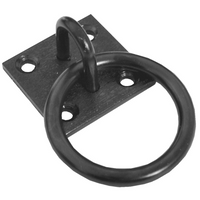
Black Epoxy Coated Ring on Plate
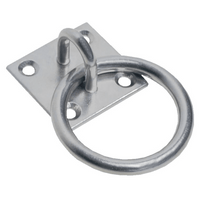
As with hook on plates, the full range is available in multiple finishes. Where the fixing point is exposed to weather, salt air, or chemical environments, stainless steel ring on plate is the correct specification. Powder coated options in red, yellow, white, and green are available where colour coding or visual identification of anchoring points matters - useful in industrial or agricultural settings where different chains serve different functions.
Staple on Plate
A staple on plate replaces the hook or ring with a U-shaped staple - a looped steel bar with both ends fixed into the plate. The closed-loop design means chain or rope passes through the arch of the staple, similar in principle to the ring on plate but with a different form factor that is often lower-profile and easier to mount flush against a surface.
Staple on plate fixings are widely used in caravan and vehicle security, equine and agricultural applications, and anywhere a compact, low-projection fixing is preferred. The two-leg design distributes load across a wider area of the plate, which can make them more resistant to lever attacks than single-projection hook fittings.
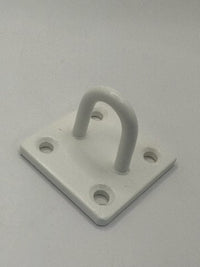
White Powder Coated Staple on Plate
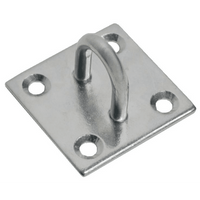
Stainless Steel Staple on Plate
Brass plated versions of both staple on plate and hook on plate fixings are also available for applications where aesthetics matter - period properties, timber gates, and heritage settings where black or powder coated steel would look out of place.
One critical installation point for all plate-mounted fixings: wherever possible, use through-bolts rather than screws alone. A through-bolt passes completely through the surface material and is secured with a nut and washer on the reverse side. This distributes the load far more effectively than a screw driven into the face, and is significantly harder to defeat. In timber gates, fence posts, or vehicle bodywork where through-bolting is practical, it should always be the preferred method.
Ground Anchors and Earth Screws
Plate-mounted fixings require an existing solid surface to attach to. In many situations - open driveways, grass areas, gravel hardstanding, allotments, or remote sites - there is no convenient wall or post. This is where ground anchors and earthscrews come in.
Earthscrew Ground Anchors
An earthscrew is a helical steel spike that is driven or screwed into the ground using a rotating action, in the same way a corkscrew enters a cork. The spiral shaft displaces and compresses the soil as it goes in, creating significant resistance to both upward and lateral pulling forces once fully seated. At the top of the earthscrew is a ring or loop through which chain or rope is passed and padlocked.
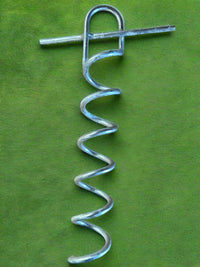
Earthscrews are particularly well suited to grass, compacted earth, and soft ground applications - securing motorcycles or bicycles on a driveway or in a garden, anchoring a caravan on a grassed pitch, tethering agricultural equipment in a field, or providing a temporary but strong fixing point on a site where permanent installation is not possible or desirable.
Installation requires no drilling, no concrete, and no specialist tools - the earthscrew can be inserted by hand using a bar or rod through the eye at the top as a lever. This also makes them removable and re-usable at a different location, which is useful for caravan owners who move between pitches or seasonal users who want security that travels with them.
The holding strength of an earthscrew depends heavily on the soil type and moisture content. In firm, well-compacted ground it will resist substantial pulling force. In waterlogged or very sandy ground, resistance is reduced. For maximum security in variable ground conditions, choose the deepest installation depth practical and consider using two earthscrews in different orientations.
Anchor Bolts
Where the installation surface is concrete, tarmac, block paving, or solid masonry, anchor bolts are the correct ground-level fixing. An anchor bolt is drilled into the surface and then expanded or chemically bonded within the hole, creating a fixing point that is integral to the structure itself rather than simply sitting on top of it.
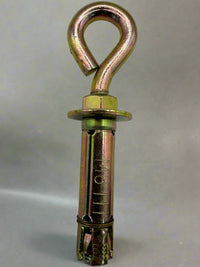
10mm Anchor Bolt - Eye Bolt Anchor
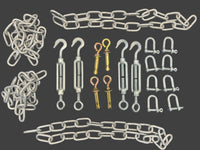
8mm Anchor Bolt - Caravan Anchoring Kit
The eye bolt design leaves a ring projecting above the surface, which chain or cable is looped through before padlocking. When correctly installed into sound concrete or masonry at the specified drill depth, an anchor bolt provides a fixing point that is extremely difficult to defeat without heavy power tools and extended effort - exactly the conditions that deter opportunistic theft and significantly slow down determined attackers.
Correct installation is non-negotiable with anchor bolts. The drill depth must match the specification for the bolt diameter. The concrete or masonry must be sound and free from major cracks in the fixing zone. The hole must be cleaned of dust before insertion. An anchor bolt set too shallow, or set into spalled or degraded concrete, will pull out under load and may do so suddenly. If you are unsure of the substrate condition, take professional advice before installing security anchor bolts.
Our caravan anchoring bolt kit provides all components needed for a complete installation, and is sized specifically for the loads involved in securing caravans and large trailers to a hardstanding.
Combined Ground and Wall Anchors
For scenarios where a fixing point needs to serve both wall-mounted and floor-level applications - a garage corner, for example, where a chain might be looped around equipment at varying heights - a combined ground and wall anchor offers versatility in a single fitting.
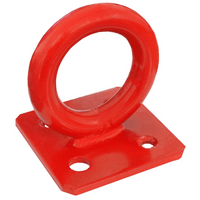
The Trojan Ground Anchor provides a more substantial, dedicated ground-level solution for high-value applications such as motorcycle security or ATV anchoring, where the chain load and theft risk justify a premium, permanently installed anchor point.
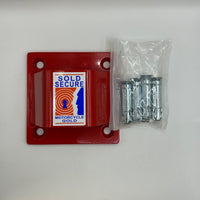
Matching the Anchor Point to the Application
Different applications have different requirements, and choosing the right anchor type from the outset avoids both under-specification (which creates security risk) and over-specification (which wastes money and makes the system harder to use).
For motorcycle and bicycle security at home, a ring on plate or staple on plate bolted through a garage wall into masonry is the standard recommendation. Paired with a heavy-duty chain and a quality closed-shackle padlock, this creates a setup that meets most insurance requirements for secured storage. Where no wall is available, a Trojan ground anchor set into a concrete garage floor is the equivalent solution.
For caravan security on a hardstanding, anchor bolts are the correct choice. The caravan anchoring kit is sized for this purpose and includes all necessary components. The chain should pass through the anchor bolt eye and loop through a structural part of the caravan chassis - not just the tow hitch, which is designed to be removed.
For temporary or portable security in grass or compacted earth areas - allotments, fields, campsites, gravel driveways - an earthscrew provides a strong, removable anchoring point that can be deployed quickly and relocated as needed.
For gate and fence chain applications, hook on plate or staple on plate fixings mounted to the gate post and gate itself are the standard method. The choice between hook and staple often comes down to how frequently the chain needs to be engaged and released - hooks are faster, staples are more secure against casual disengagement.
For equipment tethering in commercial or industrial settings - gas cylinders, wheelie bins, generators, tools - ring on plate or staple on plate fixings mounted to a solid wall or post, with chain cut to the minimum length needed to loop through the equipment, minimise the slack available for attack.
The Complete Security System
An anchor point is not a security product in isolation. It is one element of a complete system, and all elements need to be matched to each other and to the threat being defended against. A high-security anchor bolt paired with a lightweight bicycle cable achieves nothing. An excellent hardened chain padlocked to a ring on plate screwed into crumbling brick with two short wood screws is equally pointless.
The principle is simple: identify the weakest point in the system and strengthen it until it matches the strength of everything else. In most domestic and commercial security setups, that weakest point is the anchor - not the chain.
Hook on Plate
A hook on plate is a different type of anchor point altogether. It is hook rather than a secure loop. It's a steel hook welded or formed onto a flat mounting plate. As with other anchor points the plate is fixed to the surface with screws or bolts, leaving the hook projecting outward. With the hook on plate chain or rope is looped over or through the hook, and a padlock or carabiner is then used to close the loop.
Although it is not a fully secure rig hook on plate fixings are particularly useful where the chain needs to be attached and removed frequently, as the open hook allows quick engagement without threading. They are well suited to gate chain applications, tethering chains on agricultural equipment, and any setup where access speed matters alongside security.
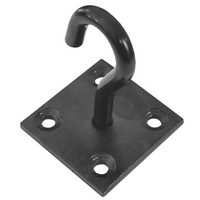
Black Epoxy Coated Hook on Plate
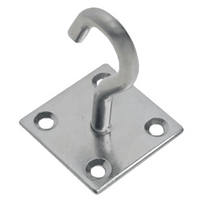
Stainless Steel Hook on Plate - ideal for marine, outdoor and coastal environments
Hook on plate fixings are available from English Chain Direct in black epoxy coated steel, stainless steel, white, red, yellow, and green powder coated options - allowing you to match the finish to the environment. For outdoor or coastal locations, stainless steel is the correct choice. For indoor workshop or garage use, epoxy or powder coated steel is typically sufficient.
Browse our full range of anchor bolts and anchoring points and our security chain range to build a complete system rated to the level of protection you need. For advice on the right combination of products for your specific application, call our team on 01483 239733 or email websales@englishchain.co.uk.