


Introduction: Why Boundaries Matter
Wherever people gather, work, play or simply pass through, boundaries serve a purpose. They guide pedestrians safely through busy spaces, protect delicate garden features from accidental damage, keep curious visitors away from dangerous drops, and help organisations manage access, flow and risk across countless environments. A well-placed boundary is one of the most practical tools available to any property owner, facilities manager, groundskeeper, event organiser or safety officer.
Yet for all their importance, boundaries are remarkably simple things. They do not always need to be immovable walls or solid fencing. In many situations, a length of chain looped between posts, a run of rope strung between cones, or a tensioned line of stainless steel wire rope is all that is needed to communicate the message clearly: this space is defined, this area is protected, this path is the safe one.
English Chain Direct has been selling chain since 1923. Over more than a century, the company has built one of the UK's broadest and most comprehensive ranges of chain, rope, wire rope, posts, bases and demarcation accessories. Whether the need is for a temporary rope-and-cone cordon at a public event, a colourful plastic post-and-chain kit for a school playground, a heavy-duty metal barrier chain alongside machinery, or a permanent stainless steel wire rope railing beside a steep drop, English Chain Direct has exactly the right product.
This guide takes a thorough look at the full spectrum of perimeter and boundary products in the English Chain Direct range, exploring the applications, benefits and considerations for each category in turn. By the end, you will have a complete picture of what is available and how to select the right product for your specific situation.
Section 1: Understanding the Perimeter Challenge
1.1 The Many Faces of a Boundary
Before exploring specific products, it is worth pausing to consider how diverse the need for boundaries actually is. The challenges facing a head groundskeeper at a cricket club, a health and safety officer at a manufacturing plant, a garden designer working on a large residential project, and an events manager coordinating a summer festival may all be described with the same word - "boundary" - but in practice they have very different requirements.
The cricket club groundskeeper needs to protect the square from being walked across during the week. The solution needs to be visible, reasonably permanent, and ideally to match the aesthetic of the grounds without creating a jarring industrial feel. Plastic chain in white or green, threaded between white spiked posts pushed into the turf, achieves exactly this - protecting the surface while looking neat and professional.
The health and safety officer at the manufacturing plant, by contrast, needs barriers that can withstand contact, will not be accidentally moved or knocked, and communicate hazard clearly and immediately. A heavy-duty epoxy-coated metal barrier chain in yellow and black, attached to robust fixing points on wall brackets or floor-mounted posts, does this job without ambiguity.
The garden designer may need to keep guests away from a newly seeded border, channel visitors along a specific path through a show garden, or protect an ornamental feature during an open day. Plastic chain in brown or green, barely noticeable against the planting, is often the perfect choice - present enough to do its job, subtle enough not to detract from the design.
The events manager needs to establish a temporary cordon quickly across a large outdoor space, demarcate a VIP area from general admission, and create clearly visible pathways that thousands of people can navigate safely. Polypropylene rope strung between traffic cones, or a run of brightly coloured plastic chain between portable posts on weighted bases, provides exactly the speed and flexibility the situation demands.
These examples illustrate a fundamental truth about perimeter products: the right solution is never one-size-fits-all. It depends on permanence, visibility, strength, aesthetics, environment, installation constraints and budget. The depth of the English Chain Direct range means that all of these considerations can be addressed.
1.2 The Role of Colour in Boundary Communication
One of the most important decisions in specifying any boundary or barrier system is colour. Colour communicates immediately and instinctively. Long before a person reads a sign or consciously processes the obstacle in front of them, their eyes have registered the colour and their brain has made its first assessment of what the boundary means. The breadth of colour options in the English Chain Direct plastic chain range - covering black, white, yellow, red, blue, green, orange, pink, brown, copper and combinations such as yellow/black, red/white, green/white and blue/white - means that any aesthetic requirement can be met, and that colour-coordinated systems are always achievable.
Yellow and black is the universal language of hazard. It draws on the same visual vocabulary as warning signs, high-visibility workwear and hazard tape. When a chain or a post is yellow and black, people understand without being told that they should be alert and cautious. This combination is ideal for industrial environments, construction sites, car parks, and anywhere that safety is the primary concern.
Red and white communicates a different message - one of prohibition and restriction. It is widely associated with no-entry situations, and is therefore a strong choice for barriers where access genuinely needs to be denied rather than simply managed.
White suggests cleanliness, organisation and officialdom. It is a popular choice for managed environments such as hotels, leisure facilities, retail settings and car parks. White post-and-chain systems have a smart, professional appearance that does not feel aggressive or industrial.
Green, brown and darker natural tones are the first choice for gardens, parks and landscaped areas where the barrier needs to blend into the environment rather than stand out from it. A brown plastic chain running between green posts virtually disappears against planting and turf, doing its protective work almost invisibly.
Blue and white is increasingly used for sports clubs and leisure facilities, matching the branding of many organisations while maintaining a clear barrier function. Red, blue and white in combination can reference national colours or club liveries.
1.3 Temporary Versus Permanent: Choosing the Right Category
Another fundamental consideration is how permanent the boundary needs to be. At the most temporary end of the spectrum, rope-and-cone systems can be put up and taken down within minutes. They leave no trace behind when removed, can be stored in minimal space, and can be redeployed in entirely different configurations from one day to the next.
Post-and-chain systems with portable weighted bases sit in the middle ground. They are more substantial than rope-and-cone arrangements and communicate a clearer sense of established boundary, but they can still be moved and reconfigured without any tools or fixings. They are a popular choice for car parks, queuing systems, pedestrian management in public spaces, and any setting where the layout needs to be flexible but the barrier needs to look more considered than a temporary cordon.
At the more permanent end, spiked posts pushed into soil create semi-permanent garden borders that are stable under normal conditions but can be repositioned without any specialist tools. Metal barrier chains attached to wall-mounted plates or ground-fixed posts are more permanent still, intended to stay in place for the long term while providing a robust physical and visual barrier.
At the most permanent and most robust end of all, stainless steel wire rope tensioned between fixed posts or anchor points creates barriers that are genuinely structural - capable of withstanding significant loads, resistant to corrosion and vandalism, and designed to last for decades without requiring replacement.
Section 2: Plastic Chain and Posts - The Versatile Everyday Barrier
2.1 Why Plastic Chain Remains the Most Popular Demarcation Choice
Plastic chain is one of the most commonly used demarcation products in the UK. The reasons for its popularity are clear: it is inexpensive, lightweight, weather resistant, easy to install, available in a wide range of colours, and instantly recognisable as a barrier boundary. The English Chain Direct range of plastic chains is one of the most comprehensive available in the UK, covering more than twenty individual products in a wide range of colours, sizes and styles. The chain is sold by the metre, making it straightforward to specify exactly the right quantity for any project, and comes with a maximum single-piece length of 25 metres - sufficient for the vast majority of applications.
The standard plastic link chain, available in 8mm size, comes in black, white, yellow, red, green, blue, orange, pink, brown, copper, red-and-white, yellow-and-black, green-and-white, blue-and-white, and red-white-and-blue. The rainbow variant, which cycles through all colours in sequence, is a popular choice for events and festive occasions. With such a breadth of choice, it is genuinely possible to match any colour scheme or to select combinations that create maximum visual impact. View the full plastic chain range →

Plastic chain available in a full rainbow of colours - Shop now →
2.2 The Full Colour Range and What Each Option Achieves
Black plastic chain is a sophisticated choice that works well in heritage settings and upmarket retail environments. White plastic chain is probably the single most popular choice for managed environments - clean, legible, and communicating a professional appearance. Yellow and black chain combines the two colours most strongly associated with hazard awareness, while red and white chain adds a further dimension of caution or restriction.
Green plastic chain is the natural choice for gardens and parks - against grass and foliage, green chain is remarkably unobtrusive. Blue and white plastic chain is popular with sports clubs and leisure facilities. Brown chain is the most discreet of earth-toned options, virtually disappearing in formal garden settings. Orange plastic chain is a high-visibility option popular in construction and industrial settings.
2.3 Diamond Spike Plastic Chain: Adding a Deterrent Dimension
Not all plastic chain is smooth-linked. The diamond spike plastic chain variants - available in dark green, black and white - serve a different purpose: not merely to define a boundary but to actively discourage people from reaching over, leaning against, or attempting to step over the chain. Diamond spike chain features protruding pointed links that make contact uncomfortable. In garden settings, dark green diamond spike chain is particularly effective, combining the natural camouflage of the green tone with a physical deterrent that protects delicate borders, recently planted areas or formal parterres.
2.4 Posts, Bases and the Complete System
Plastic chain on its own is only half the story. For the chain to function as a barrier, it needs something to hang from, and English Chain Direct's comprehensive range of posts, bases and accessories ensures that the complete system can be assembled from a single supplier.
The coloured plastic post is the cornerstone of the post-and-chain barrier system. Available in black, white, yellow, red, blue, green, and other colours to match the chain range, these posts feature attachment points that hold the chain at a consistent height. The ability to match post and chain colour - or to deliberately contrast them for visual effect - is one of the key advantages of buying a complete system from a specialist supplier.
The posts are designed to work with two types of base. The round plastic fillable base can be weighted with water, sand or gravel, creating a stable free-standing support that can be moved and repositioned without tools. The square rubber base offers an alternative weight distribution more suited to outdoor applications.
For garden applications where free-standing bases would look cumbersome or out of place, the white plastic spiked post provides an elegant alternative. Its integrated spike is simply pushed into the soil, creating a secure, low-profile support that holds the chain at the right height without any base plate or weighted support.

Posts, bases and connectors for complete barrier systems - Shop now →
2.5 Connectors, Joining Links and Extensions
One of the most practical features of the English Chain Direct plastic chain system is the range of connector accessories. These include plastic joining links, connector links and connector hooks, all available in multiple colours. For applications that require a metallic connector rather than a plastic one, the range of metal quicklinks provides a complementary option - small oval metal links available in zinc-plated and stainless steel variants that can join lengths of plastic chain or attach chain to anchor points and fixings.
2.6 Ready-Made Post and Chain Kits
For customers who want a complete, ready-to-deploy barrier system without the need to specify individual components, the English Chain Direct post and chain kits offer an excellent solution. These kits contain matched posts, bases, chain and connectors in coordinated colour schemes, providing everything needed for immediate deployment. Colour schemes include yellow/black, black, white, red/white, blue/white, green/white, and red/blue/white.
These kits are particularly popular with events companies, facilities managers, sports clubs, and businesses that need a professional-looking barrier system that can be deployed quickly, adjusted easily, and stored compactly when not in use. View all post and chain kits →
Section 3: Rope, Posts and Cones - Speed, Flexibility and Long-Distance Coverage
3.1 When Rope, Posts and Cones Are the Right Answer
There are many situations where a chain-and-post system, for all its virtues, is not the right tool. When a perimeter needs to be established quickly across a large area with irregular geometry - a field, a car park, an outdoor event space, a road closure - the combination of polypropylene rope and traffic cones offers something that no other boundary system can: complete freedom of layout with very rapid deployment.
Rope-and-cone systems require no posts, no bases, no connectors. The rope is simply looped around the cone or tied to an end cap, and the cones provide the visual markers that keep the rope suspended at the right height and signal the boundary to people approaching from any direction. For something a little bit more visually arresting and robust, plastic posts can be employed - these can have multiple ropes attached giving much more flexibility. The entire rig can be set up or moved by a single person in a fraction of the time that a post-and-chain system would require.
This makes rope combined with cones or posts the first choice for events management - establishing pedestrian channels at outdoor festivals, creating temporary queuing systems, managing crowd flow around stages or exhibition areas. They are equally effective for local authorities managing road closures, construction teams establishing temporary safety perimeters, and sports clubs marking out spectator areas around pitches or courts.
3.2 Polypropylene Rope: Properties and Advantages
Polypropylene rope is the ideal material for outdoor barrier and demarcation applications. It combines several important properties that make it well-suited to the demands of perimeter work. Polypropylene is waterproof and highly resistant to rot, mould and UV degradation. Unlike natural fibre ropes, it will not weaken, stiffen or deteriorate when left outdoors in wet conditions.
It is also extremely lightweight - lighter than most other rope materials of equivalent strength - which makes it easy to handle, transport and store. A 50-metre coil of polypropylene rope adds minimal weight to a vehicle or storage space, and can be carried and deployed by a single person with no difficulty.
The rope floats on water, which makes it a particularly good choice for barriers near ponds, rivers, lakes or swimming pools. The English Chain Direct range of polypropylene rope is available in a wide selection of colours including blue, white, yellow, green and orange. The rope is sold by the metre, making polypropylene rope one of the most cost-effective boundary solutions available for applications where the perimeter covers large distances.
3.3 Traffic Cones: Types, Sizes and Applications
English Chain Direct supplies polythene demarcation cones in two sizes - 300mm high and 500mm high - offering a choice of profile to match different applications. The smaller 300mm cone is ideal for situations where a low-profile marker is appropriate: narrow pedestrian channels, indoor events, low-footprint temporary barriers where the cone needs to be unobtrusive. The taller 500mm cone provides greater visual impact and is the better choice for outdoor events, road-side applications, and any situation where the boundary needs to be clearly visible from a distance or at speed.
The cones are made from polythene, which provides good resistance to impact and to outdoor conditions. Unlike the stiff, brittle polymer materials used in cheaper cones, polythene cones flex on impact rather than cracking - an important quality in environments where cones may be kicked, driven over accidentally, or caught by wind. Storage space is always finite and the cones stack neatly on top of each other, taking up as little room as possible.
3.4 Plastic Posts: A More Formal Step Up from Cones
Where traffic cones serve admirably as quick-deployment anchor points for rope, they are by their nature informal. Their squat, tapered profile is universally associated with temporary works and ad hoc closures - entirely appropriate in many settings, but not always the right visual register. When an event, facility or outdoor space requires a boundary that reads as considered and deliberate rather than simply functional, plastic posts on weighted bases provide a meaningful step up in formality without sacrificing the flexibility that makes free-standing systems so practical.
The coloured plastic posts available from English Chain Direct are purpose-built for post-and-chain barrier systems. Tall and upright, they hold chain at a consistent, intentional height and create a boundary that communicates permanence and organisation. Unlike a cone - which is self-evidently a temporary measure - a post-and-chain system suggests that the boundary has been designed, not just thrown up in a hurry. This distinction matters considerably in settings where the impression given to visitors, customers or the public reflects on the organisation responsible.
The posts are available in a range of colours - including black, white, yellow, red, blue and green - and are designed to be used with the round plastic fillable base or the square rubber base, both of which provide free-standing stability without any drilling or ground fixing. The round fillable base can be loaded with water, sand or gravel to provide substantial weight while remaining light and portable when empty.
The posts also offer a practical functionality that cones cannot: the A4 plastic sign holder, which mounts directly to the post, transforms a simple boundary marker into an information point. Queue management instructions, directional guidance, event signage and safety notices can all be displayed at eye height alongside the chain, turning the barrier into an active communication tool rather than a passive boundary.
3.5 Rope Boundaries in Practice: Applications Across Settings
The versatility of rope-based systems means they find application across an enormous range of settings. At outdoor music festivals, polypropylene rope is used to create pathways between stages, to establish the boundaries of campsites, and to manage the flow of tens of thousands of people safely through complex site layouts. The ability to reconfigure quickly means that systems can be adjusted as crowd patterns change through the day.
In construction and utilities, temporary rope-and-cone cordons around excavations, equipment storage areas, and active work zones protect both workers and the public. For car parks and traffic management, rope and cones can close off sections quickly for maintenance, establish temporary parking bays for events, and guide drivers through unfamiliar layouts.
Section 4: Metal Barrier Chain - Strength and Permanence for Demanding Applications
4.1 When Rope or Plastic Chain is Not Enough
Rope and plastic chain are versatile and cost-effective, but there are situations where their relatively modest physical strength is not sufficient. Where a barrier needs to withstand sustained contact, resist vandalism, remain secure in all weather conditions, and communicate through its appearance that it is a serious and permanent fixture, metal chain is the right choice.
Metal barrier chains occupy an important middle ground between the light demarcation of plastic chain and the full structural capability of steel wire rope. The English Chain Direct range includes two key barrier chain products: the 6mm x 42mm epoxy coated electro-galvanised steel welded barrier chain in yellow and black, and the same chain in red and white. These two products represent the standard for metal barrier chain in UK demarcation applications.
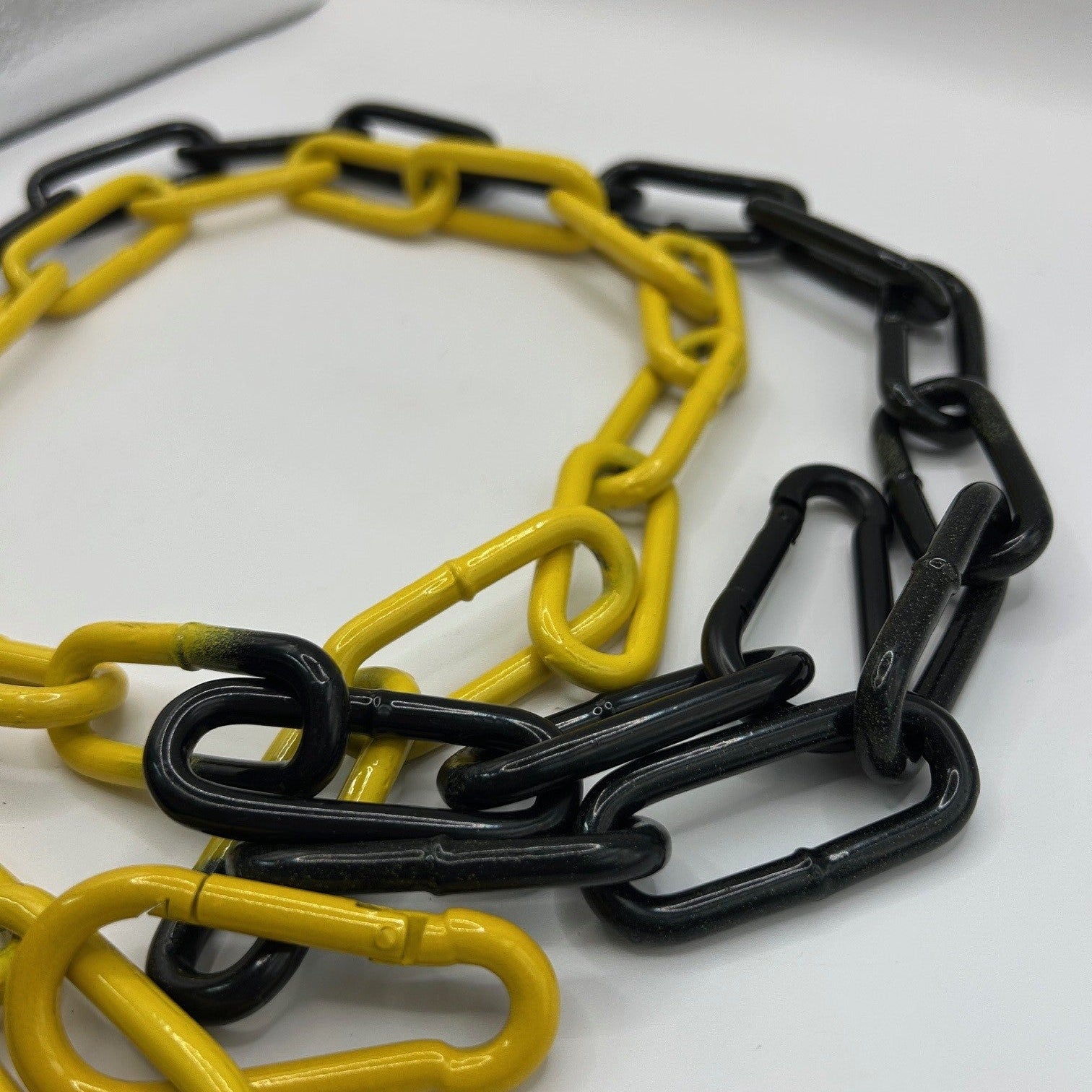
Epoxy Barrier Chain - Yellow/Black - Shop now →
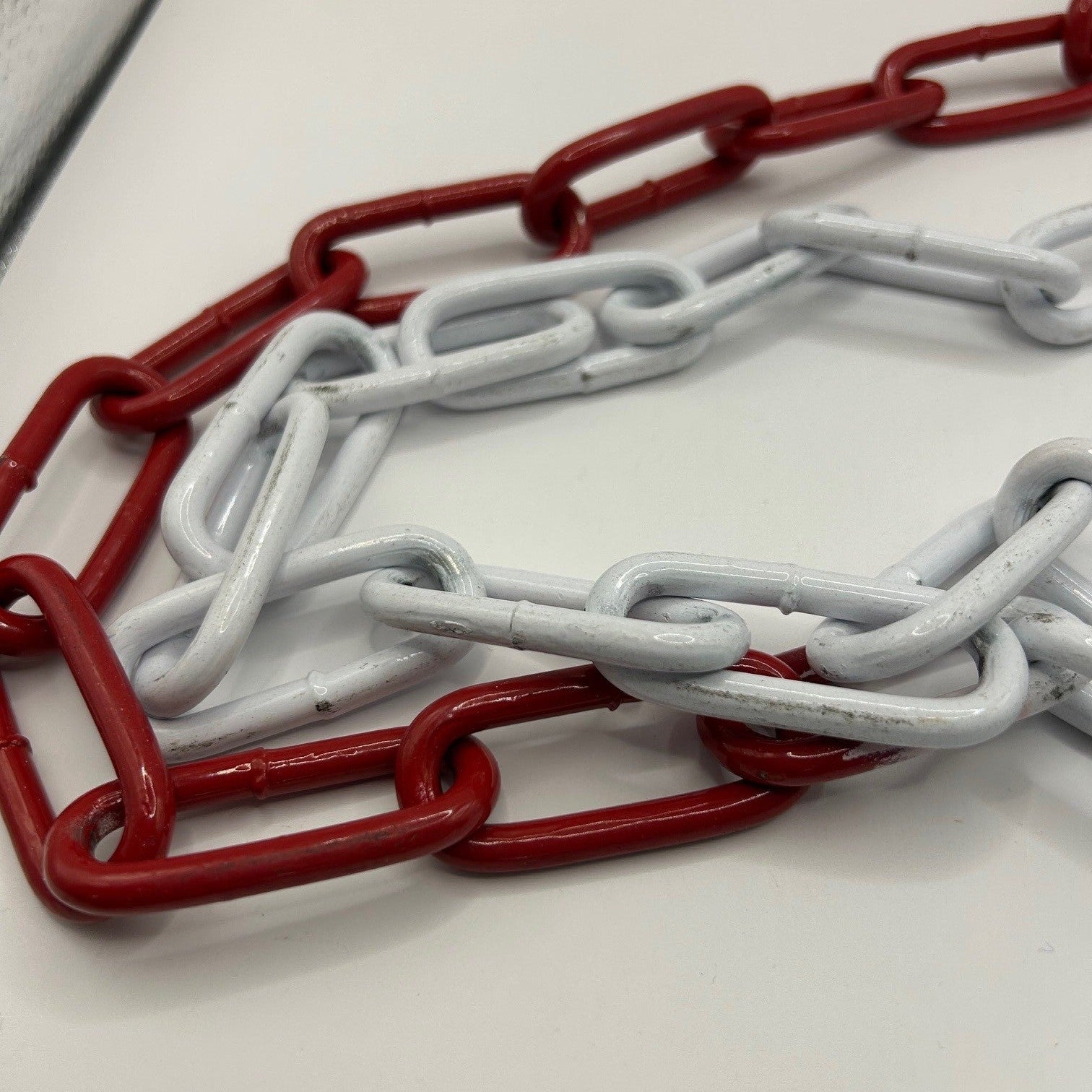
Epoxy Barrier Chain - Red/White - Shop now →
4.2 Epoxy Coated Electro-Galvanised Barrier Chain: Technical Specification and Benefits
The 6mm x 42mm epoxy coated electro-galvanised steel welded barrier chain is a purpose-built product that combines the strength of steel with a weather-resistant and highly visible finish. The base chain is made from welded steel wire with a 6mm diameter and 42mm x 12mm inside link dimensions, giving it substantial physical strength. The electro-galvanising process creates a zinc coating that provides a first layer of corrosion protection, while the outer epoxy polyester coat provides both the colour and an additional barrier against moisture, UV and environmental degradation.
The yellow and black version uses alternating yellow and black link sections to create a high-impact visual pattern that is immediately associated with hazard awareness. The red and white version serves a different visual purpose, communicating restriction and no-entry more than general caution. Both are available in cut lengths by the metre up to 30 metres, and also in 10-metre boxes.
4.3 Diamond Spike Metal Chain: The Active Deterrent
For applications where proximity deterrence is required in addition to simple boundary demarcation, the hot galvanised steel diamond spike chain takes the barrier function to another level. This chain incorporates pointed projections on alternate links, creating a tactile and visual deterrent that actively discourages anyone from reaching over, leaning against, or handling the chain.
The hot galvanising process provides excellent corrosion resistance, making this chain well suited to outdoor use in all weather conditions. An epoxy-coated version of the diamond spike chain is also available, providing the same deterrent profile in a lighter-weight and more affordable material for garden and lighter-duty applications. The dark green plastic diamond spike chain is particularly popular for garden use.
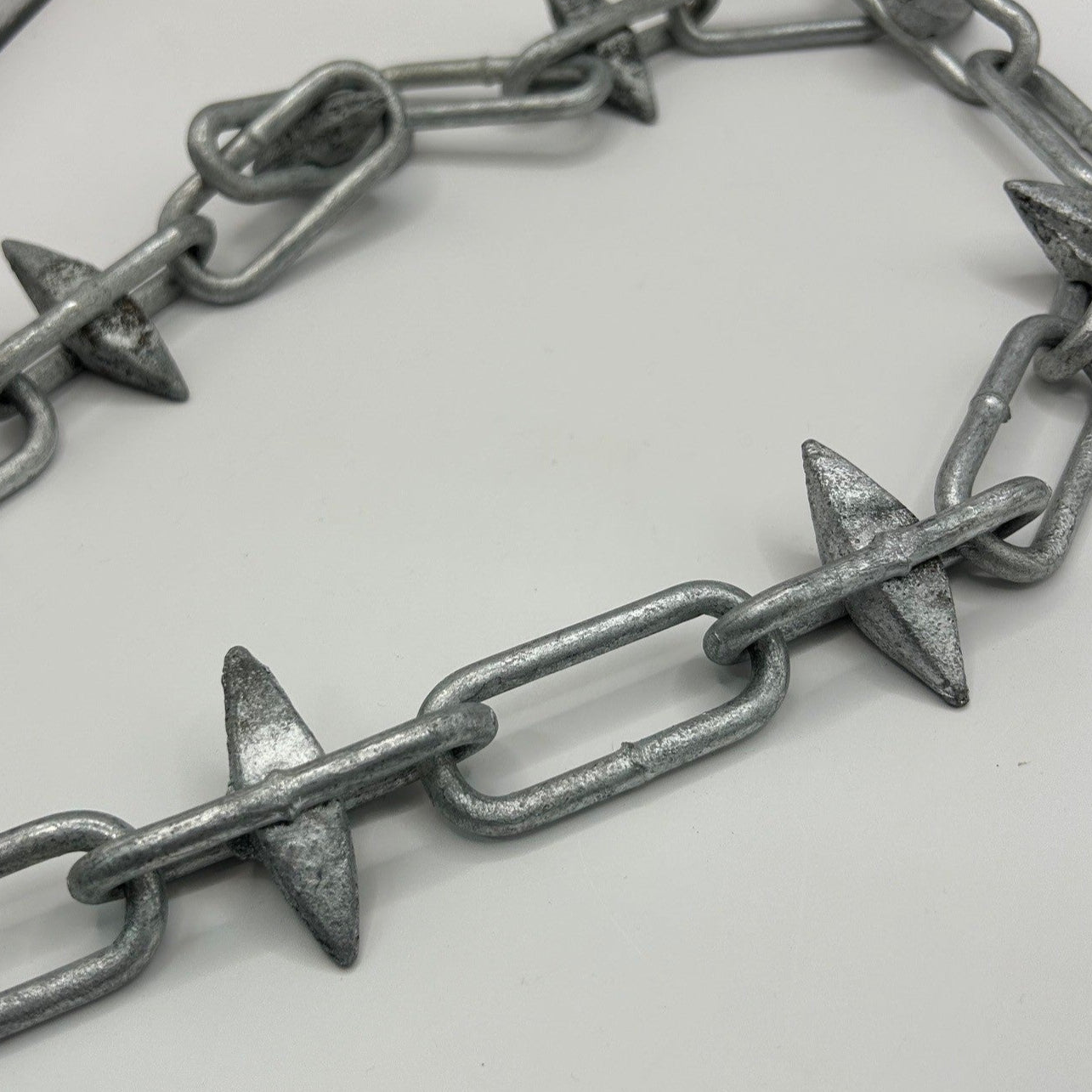
Hot Galvanised Diamond Spike Chain - active proximity deterrent - Shop now →
4.4 Fixing Points, Wall Plates and Chain Anchors
A metal barrier chain is only as good as its fixing points. English Chain Direct supplies a range of fixing accessories including chain plates available as hook-on, ring-on and staple-on variants, which provide the wall and post mounting points to which chain can be directly attached. For connecting chain sections and attaching chain to fixing points, metal quicklinks are available in zinc-plated and stainless steel variants.
Section 5: Stainless Steel Wire Rope - Permanent, Strong and Architectural
5.1 The Case for Wire Rope in Barrier Applications
For applications where the barrier needs to provide genuine structural resistance - not merely visual demarcation - stainless steel wire rope is the appropriate choice. Wire rope barriers are used in architecture and civil engineering to provide fall protection beside drops and level changes, to create handrail systems along ramps and staircases, to protect pedestrians from machinery or vehicle traffic in industrial settings, and to establish permanent perimeter security around hazardous areas.
The use of AISI 316 marine-grade stainless steel provides corrosion resistance appropriate for demanding outdoor and marine environments. Grade 316 stainless steel contains molybdenum, which provides superior resistance to chloride corrosion. This makes it the right choice for coastal installations, swimming pool perimeters, food processing facilities, marine infrastructure, and anywhere the barrier will be exposed to salt water, cleaning chemicals or other corrosive substances. View stainless steel wire rope →
5.2 Wire Rope Specifications and Construction
The 7x7 stainless steel wire rope - available from £6.84 per metre in a range of diameters - uses a construction of 7 strands of 7 wires each, giving 49 individual wires in total. This construction balances flexibility with tensile strength: the relatively high strand count provides good flexibility and resistance to fatigue cracking under repeated movement, while the 49-wire construction delivers substantial breaking loads appropriate for barrier applications.
5.3 Installation Kits and Fittings
One of the most useful aspects of the English Chain Direct stainless steel wire rope range is the availability of complete installation kits. These kits include the wire rope cut to length together with all necessary end fittings. Two key kit types are available: the small eye plate kit uses eye plate fixings that can be mounted to walls, posts or structural steelwork; the small eye bolt kit uses through-bolt fixings that provide a stronger attachment where the structure permits drilling and bolting. Both are available in 5-metre lengths and include hardware to tension and secure the rope at both ends.
5.4 Applications for Stainless Steel Wire Rope Barriers
Next to drops and level changes, stainless steel wire rope provides genuine fall protection. Depending on the height and the regulatory context, a single run of wire rope at handrail height may be sufficient, or a multi-strand system with wire at intermediate heights may be required. The clean, architectural appearance of stainless steel wire rope makes it suitable for high-quality built environments where a more industrial barrier would be visually inappropriate.
Beside water - rivers, lakes, ornamental ponds, canal towpaths and swimming pool perimeters - wire rope barriers provide protection that is both physically effective and visually appropriate. In industrial and manufacturing settings, wire rope barriers establish clear separation between pedestrian walkways and production equipment. For high-quality domestic gardens, wire rope barriers alongside drops, retaining walls or water features provide an elegant solution that complements contemporary hard landscaping materials.
Section 6: Application Guide by Environment
6.1 Gardens and Landscaped Areas
For informal garden borders, the white plastic spiked post is the first choice. These posts push directly into the soil and require no base. When combined with plain white plastic chain or the more discreet green or brown plastic chain, they create a smart and effective border that protects planting without dominating the space.
For more formal garden settings, the diamond spike plastic chain in dark green provides both a visual boundary and a proximity deterrent. Against a dark green hedge or planted border, this chain is remarkably unobtrusive; the spike profile communicates clearly to visitors that reaching over the chain is not desirable.
For gardens with significant level changes, water features or drops, the stainless steel wire rope kit provides a genuinely safe solution that can also be beautiful. The reflective quality of polished stainless wire rope adds a subtle visual interest rather than detracting from the garden design.
6.2 Sports Clubs and Playing Surfaces
For protecting playing surfaces - cricket squares, bowling greens, tennis courts, croquet lawns - plastic chain on spiked posts provides the ideal combination of simplicity, low visual impact, and easy removal when the surface is in use. White chain on white posts has become the standard for bowls clubs and cricket clubs.
For spectator management on match days, a post-and-chain system with portable weighted bases is the most flexible option. At swimming pools and aquatic facilities, blue and white post-and-chain systems are widely used to manage poolside traffic and establish safety zones at the poolside edge.
6.3 Industrial Facilities and Workplaces
In industrial and workplace environments, the epoxy coated electro-galvanised barrier chain in yellow and black is the most commonly specified product. Used with robust floor-fixed or wall-mounted fixing plates, this chain creates permanent barriers that do not shift, sag or deteriorate. Diamond spike metal chain adds a further deterrent dimension in environments where unauthorised access attempts are anticipated.
6.4 Car Parks and Traffic Management
Post-and-chain systems with portable weighted bases are extensively used in car parks for queue management, creating pedestrian channels, and protecting pay-and-display machines and EV chargers. For more permanent applications, wall-mounted chain plates with metal barrier chain provide a robust and permanent solution. At car park entrances and access control points, polypropylene rope or plastic chain strung between removable posts provides a cost-effective and flexible solution for managing temporary closures.
6.5 Event Venues and Public Spaces
The combination of polypropylene rope and traffic cones provides the most scalable and flexible solution for large outdoor events. A team of two people can establish a 200-metre perimeter in minutes. For areas requiring a more defined and substantial barrier - VIP areas, backstage access, stage perimeters - post-and-chain kits in appropriate colours provide a step up in quality and visual communication.
6.6 Waterside and Riverside Applications
For permanent waterside barriers where physical protection against falls is required, stainless steel wire rope provides the most appropriate combination of physical strength and aesthetic quality. The corrosion resistance of grade 316 stainless steel means the barrier will remain structurally sound and visually acceptable for many years in an aquatic environment.
Where the requirement is advisory rather than structural - marking the edge of a fishing bank, identifying the boundary of a swimming area - plastic chain in bright colours on spiked posts provides an economical and effective solution.
Section 7: Connecting It All - Quicklinks, Joining Links and Fixings
7.1 The Importance of Connection Hardware
A barrier system is only as strong as its weakest connection. English Chain Direct supplies a comprehensive range of connection hardware including plastic joining links and connector hooks for the plastic chain system, and metal quicklinks that provide stronger connections and attachment to anchor points.
7.2 Metal Quicklinks: Versatility Across the Range
Metal quicklinks are one of the most versatile items in the barrier hardware range. These small oval links with a screw-closure mechanism can be used to connect chain sections, attach chain to fixing plates, link chain to posts, and create closed loops in chain runs. Available in zinc-plated steel and stainless steel, they provide connection options for both standard outdoor environments and corrosive or marine environments.
The key advantage of a quicklink over a welded connection is adjustability: the screw closure can be opened and re-closed as many times as needed, allowing the chain to be repositioned, extended or reconfigured without cutting. The stainless steel quicklinks are the appropriate choice for connections exposed to outdoor conditions over the long term, particularly in environments where corrosion is a concern.
7.3 Chain Plates and Fixing Hardware
For applications where chain needs to be attached to a fixed structure, chain plates provide the specialist mounting hardware that makes this secure and purposeful. Hook-on plates accept a standard chain hook or carabiner clip, allowing the chain to be attached and removed easily without tools. Ring-on plates provide a fixed ring for more secure connection. Staple-on plates use a U-shaped staple fixing for timber posts in garden and estate applications.
Section 8: Safety, Compliance and Best Practice
8.1 Understanding Your Safety Obligations
In the UK, the Health and Safety at Work Act 1974 and the Management of Health and Safety at Work Regulations 1999 impose a general duty of care on employers and property owners to ensure that people in or near their premises are not exposed to unnecessary risk. Where barriers are used as risk control measures - preventing access to machinery, protecting against falls, managing traffic and pedestrian flow - they form part of the overall risk management framework and need to be appropriate for their intended purpose.
It is important to distinguish between demarcation products - which communicate boundaries and guide behaviour through visual cues - and structural fall-prevention products, which are designed to physically resist the loads imposed by a person in the event of a fall. Plastic chain and most metal barrier chains are demarcation products. Stainless steel wire rope, when correctly specified and installed, can function as part of a structural fall-prevention system. For guidance, call the English Chain Direct team on 01483 239733.
8.2 Maintenance and Inspection
For plastic chain systems, inspection involves checking for cracking, discolouration or embrittlement of the chain links, checking that connectors and joining links are secure, and verifying that posts and bases remain stable and correctly positioned. Plastic chain will eventually be degraded by UV exposure over a period of years, and should be replaced when it begins to show signs of deterioration.
For metal barrier chain, inspection should check for corrosion, damage to the coating, and integrity of the fixing points. For stainless steel wire rope, periodic inspection should check for broken wires, kinking, corrosion, and the security and condition of all end fittings and anchor points.
Section 9: Choosing the Right Product - A Decision Framework
9.1 The Key Questions to Ask
How permanent does the boundary need to be? If it will be moved regularly, or if it is entirely temporary, rope and cones or portable post-and-chain kits are the right starting point. If it will remain in position for months or years, a more permanent fixing approach - spiked posts, wall-mounted plates, ground-fixed posts - is appropriate.
What load does the barrier need to withstand? If the barrier is purely a visual and social guide - keeping people on a path, protecting a garden border, managing a queue - plastic chain or rope is entirely appropriate. If the barrier needs to physically resist contact or provide fall protection, metal chain or wire rope is required.
What are the aesthetic requirements? If the barrier needs to blend into its surroundings, earth tones and green are the right choice. If it needs to stand out for safety reasons, yellow, black, orange or red are appropriate. If it needs to look smart and professional in a commercial setting, white or coordinated colour systems provide the right appearance.
9.2 Recommended Combinations for Common Applications
For protecting garden flower beds from pedestrians: white or green plastic spiked posts with white, green or brown plastic chain. For added deterrence, dark green diamond spike plastic chain.
For managing queues and pedestrian flow in retail or commercial settings: white coloured plastic posts with round fillable weighted bases, with white or blue-and-white plastic chain. Complete ready-made kits available for immediate deployment.
For industrial hazard demarcation and machinery barriers: epoxy coated yellow-and-black metal barrier chain with wall-mounted hook or ring plates. Diamond spike metal chain where proximity deterrence is required.
For temporary event cordons and crowd management: orange or yellow polypropylene rope with 300mm or 500mm polythene demarcation cones.
For permanent safety barriers beside drops, water or machinery: stainless steel wire rope with complete installation kits.
For access restriction across driveways, gateways and entrances: epoxy coated red-and-white or yellow-and-black metal barrier chain on hook-on plates, allowing easy removal for authorised access.
Section 10: Why English Chain Direct
10.1 A Century of Chain Expertise
English Chain Direct is not simply a product catalogue - it is the retail expression of a company that has been manufacturing, sourcing and supplying chain since 1923. That history matters. More than a century of experience in the chain industry means that the team understands chain applications in a way that a general hardware supplier cannot match. The English Chain Direct team can be reached by phone on 01483 239733 for product advice and system configuration guidance.
10.2 Competitive Pricing and Free Delivery
The breadth and depth of the English Chain Direct range is matched by a commitment to competitive pricing. Free delivery is available on orders over £75, with some area exceptions. The ability to order chain by the metre rather than in fixed packs means that customers pay only for the quantity they actually need.
10.3 The Complete One-Stop Solution
Perhaps the most significant practical advantage of buying boundary and barrier products from English Chain Direct is the ability to source everything from a single supplier. Posts, bases, chain, rope, cones, connecting hardware, fixing plates and specialist products are all available from a single source, ensuring compatibility, coordinated delivery and a single point of contact for any queries or issues.
Conclusion: Building Boundaries That Work
Boundaries are everywhere. The English Chain Direct range - built over more than a century of experience - provides solutions for every point on the spectrum. At the lightest and most flexible end, polypropylene rope and polythene cones provide fast, cost-effective, endlessly redeployable cordons for temporary applications.
In the middle ground, plastic chain in dozens of colours, with a comprehensive system of posts, bases and connectors, provides the most versatile and widely applicable barrier system available. At the stronger and more permanent end, metal barrier chain with robust fixing hardware provides genuine physical resistance and long-term durability. And at the top of the specification range, stainless steel wire rope provides the corrosion-resistant, architecturally appropriate, genuinely structural barrier capability needed in the most demanding applications.
To explore the full range, visit www.englishchaindirect.co.uk. For expert advice, call 01483 239733 or email websales@englishchain.co.uk.